

Blog

Table of contents
Want to assess your organisation’s talent at a glance? You might use the 9-box talent grid. Business owners and HR professionals regularly use this simple system to visualise the performance and potential of a given workforce.
The 9-box talent grid is popular for good reason, but it also comes with a few caveats. In this article, we cover how, when, and ultimately whether to use the 9-box talent grid.
What is a 9-Box Talent Grid?
Picture exactly what it says on the tin: a 3x3 grid. The horizontal axis plots low, medium and high performance while the vertical axis plots low, medium and high potential. Employees are then categorised into one of these nine boxes according to how they align on each axis.
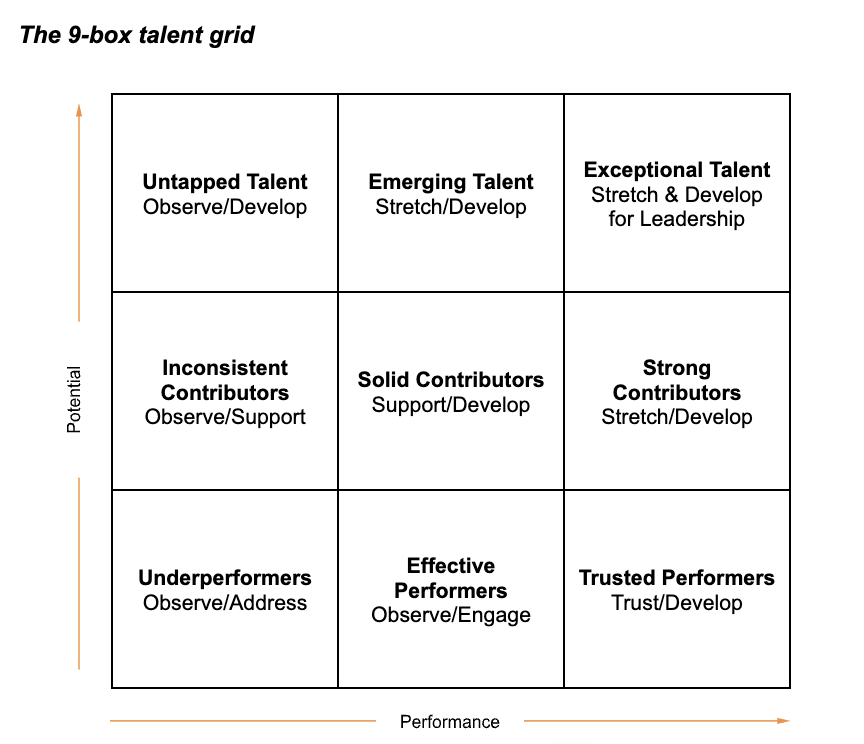
The 9-box talent grid can help to reveal high-potential employees, emerging leaders, and where talent development might be best directed within the workforce. Essentially, it helps you to both assess and anticipate capability.
First developed by McKinsey for GE in the 1970s, the grid has since proven very popular for the purposes of talent management and succession planning.
How Organisations Use the 9-Box Grid
As many as 64% of organisations use the 9-box grid to make informed, strategic decisions about talent development. These decisions tend to centre around three core areas:
Identifying Exceptional Talent
High-performing, high-potential employees could be your next Senior Director or CEO. Organisations that can identify exceptional talent can focus on engaging, retaining and nurturing that talent effectively.
Addressing Skill Gaps and Development Opportunities
Disengagement and skill gaps can have high costs. Organisations that pinpoint those issues can not only focus their training and development efforts more precisely for internal mobility, but can also identify gaps where external recruitment is genuinely needed.
Did you know?
65% of Australian business leaders identify skill gaps as a key barrier to business transformation, according to the WEF’s Future of Jobs Report 2025.
Informing Succession Planning
Succession planning involves identifying future leaders so they’ll be able to fill leadership roles as they become vacant. Organisations that have a clear succession plan can develop their emerging leaders so they’ll be truly prepared when the need arises.
Did you know?
55% of executives say their organisation underutilises the workforce intelligence it has today, according to Mercer’s Global Talent Trends 2026.
Benefits of Using the 9-Box Talent Grid
The 9-box talent grid has both its enthusiasts and its critics, but here are some key reasons why it’s still widely used by organisations across all sectors:
- It’s easy to use and understand: This visual model can quickly communicate talent strengths and opportunities across the workforce, and help get buy-in from leadership when it comes to internal talent development.
- It gives you a comparative view of your internal talent: Getting everyone (literally) on the same page can be helpful. The grid clarifies where employees stand relative to their peers and provides transparency into comparative performance.
- It helps you align L&D plans with HR strategy: Your learning and development initiatives become far more efficient and effective when they’re truly aligned with your strategic talent goals.
Did you know?
Only 20% of Australian workplaces say that their training plans and strategic workforce plans are currently integrated.
Defining Performance and Potential in a 9-Box Grid?
The first step for any 9-box talent grid is to define what performance and potential actually look like for the organisation. The metrics can vary, but here’s a general guide:
Low performance might mean the employee is failing to meet their job criteria and their individual targets. High performance might mean fully meeting all of these.
Meanwhile, low potential might look like a lack of interest in improving or an inability to improve if the employee is at maximum capacity. Meanwhile, high potential might look like a keen interest in taking on more complex roles and responsibilities. Organisations might also plot potential via metrics like leadership behaviours, learning behaviours, adaptability, engagement or initiative.
The next task is to individually assess each employee’s performance and potential against those chosen metrics, and then plot employee names into the appropriate category. It’s then helpful to develop an action plan for each category. Which leads us to…
How Does the 9-Box Grid Work for Talent Management?
The whole point of creating our nine employee segments is to implement suitable talent management approaches for each one. Let’s walk briefly through these different categories and what its approach could look like. These are suggestions only, so adjust to suit.
Underperformers
Underperformers show low performance and potential with a limited growth trajectory. This category of employees may require immediate attention and performance management. A performance improvement plan and support can guide the way forward, with a role shift or termination as possible outcomes if performance doesn’t improve.
Effective Performers
Effective performers demonstrate a medium level of performance and low potential. It’s worth observing these employees to determine whether they’re simply happy where they are, or whether employee engagement measures could help re-engage them in their career pathway.
Trusted Performers
Trusted performers demonstrate high performance and low potential; they’re often valuable and dependable subject matter experts who love the ‘doing’ but might not show interest in leading. Once employee disengagement is ruled out, talent in this category might simply feel fulfilled in their current position. They can often be trusted to develop training initiatives and manage key communications due to their high capability.
Inconsistent Contributors
Inconsistent contributors might demonstrate irregular performance, yet show a desire to progress. These employees may benefit from encouragement, coaching, stretch assignments, and clear discussions to pinpoint any causes for varying performance.
Solid Contributors
In the middle of the grid, we see solid contributors who offer medium performance and medium potential; these tend to represent core employees. Be careful not to overlook this section, as these well-rounded employees can develop along both axes with thoughtful coaching and leadership development.
Strong Contributors
Strong contributors demonstrate high performance and medium potential. They may be leadership material, but could plateau without support, and as such will probably benefit from encouragement and development to help them reach the next level. Stretch assignments can help challenge employees in this category.
Untapped Talent
Untapped talent can be keen to progress but not quite delivering in their role, combining low performance with high potential. They may be new to their role or in the wrong role. Talent in this category tends to respond well to learning and development initiatives, particularly with clear career pathways and a good role fit.
Emerging Talent
Emerging talent has medium performance and high potential. These employees can often benefit from technical upskilling, cross-department experiences or stretch assignments to optimise their performance and sharpen their skillsets.
Exceptional Talent
Exceptional talent describes those rare employees who show high performance and high potential, indicating a strong suitability for leadership and more complex roles. Only a small proportion of high performers also qualify as high potential. This is because many high performers can have difficulty adjusting to leadership roles. Organisations can challenge these self-motivated employees with stretch assignments and support them with tailored executive coaching.
Did you know?
High-potential employees can boost the performance of colleagues sitting nearby by 15%, which makes them productivity amplifiers in the workplace.
Using the 9-Box Talent Grid for Succession Planning
The strength of the 9-box talent grid is that it can quickly highlight where strong capabilities intersect with an ambition to advance. It’s for this reason that the grid can be helpful in planning for future leadership vacancies.
Naturally, it’s not as straightforward as simply earmarking anyone in the ‘exceptional talent’ category for upcoming management roles. All talent can benefit from L&D support. However, those in the top-right corner of the grid are likely to be both skilled and driven professionals who respond well to leadership training.
It’s also important to be aware of potential bias in the plotting process and how this can affect who can rise through the ranks. This leads us to…
Limitations and Criticisms of the 9-Box Grid
As popular as the 9-grid talent box is, it isn’t without its limitations and potential pitfalls. When using the grid, consider:
- The subjective metrics: The grid is only as robust as its performance and potential metrics. Potential can be particularly difficult to assess objectively.
- The fixed time reference: The grid reflects a certain moment in time, so it’s important to revisit the document regularly and update it as needed.
- The energy of early-career vs established professionals: The potential axis can overly highlight early-career professionals who are fresh and enthusiastic about their careers. Be mindful not to overlook more established talent who could be re-engaged with personalised encouragement and support.
- The time investment: If you’re getting bogged down in the details of who fits where, consider that some organisations simplify the process further with the four-box grid consisting of Underperformers, Solid Performers, Untapped Talent and Exceptional Talent.
- Personal biases: Unconscious bias can creep into any subjective process. A 2022 analysis of extensive 9-box data found that organisations persistently underestimated the potential of their female employees. Similarity bias can also arise, where managers favour those with familiar work styles. Ensuring there are diverse voices involved when plotting the grid will help address potential biases.
It’s also worth noting that publicising the grid within the organisation could lead to demotivation or competition, so it’s best used as an internal HR tool while remaining transparent about each employee’s career journey.
These points aren’t a reason to forego the 9-box grid; they’re just factors to keep in mind. The 9-box grid also isn’t the only model of framework to use in effective HR. Modern talent management is multifaceted and nuanced, so the approach to it should be too.
Broad Strategies for Improving Performance and Potential
In certain situations, it’s worth knowing how to enhance performance and potential on an organisation-wide basis.
Improving performance is largely about removing barriers in the present. Focusing on communication, skillsets or workplace conditions can help. That could look like: skills training, structured feedback, clearer goal setting, and/or improving workplace culture.
Improving potential is more about providing the opportunities and motivation for employees to advance. That could look like: clear career pathways, mentorships, stretch assignments, team coaching, and/or cross-team collaboration.
Is the 9-Box Grid Right for Your Organisation?
The 9-box talent grid can provide fast clarity and structure to conversations about talent, particularly when it comes to succession planning and allocating development resources. Whether it’s right for your organisation ultimately depends on your talent management processes and needs. It can be a very useful tool, but it works best when used thoughtfully alongside other proven HR methods and frameworks.
If you could use some support in developing your performance and potential, HumanX can assist through outsourced HR services and consulting.