

Blog

Table of contents
Imagine a business where top talent leaves just as fast as they’re brought on board, teams struggle with vague expectations, and leaders make HR decisions based on incomplete data. For many organisations, this is the reality of managing a workforce without a solid strategy in place.
Human Capital Management (HCM) offers a solution. Spanning the entire employee lifecycle, HCM uses technology and data to boost productivity, engagement, and growth. All the while, it ensures employees remain engaged and satisfied, because what’s a successful business without a committed workforce?
In this article, we’ll break down the key elements of HCM, the benefits it delivers, and the pain points it addresses. Plus, we’ll show why combining the technology with skilled HR support is often the most effective way to turn data into measurable results. Let’s get started.
What Is Human Capital Management (HCM)?
Human capital management (HCM) is a strategic approach that views a company’s workforce as a core asset rather than an expense. The primary goal is to attract and retain people in a way that directly supports business outcomes.
HCM does this by maximising employees’ potential and continuously supporting their development through their entire lifecycle, from recruitment and training to performance management and compensation.
Unlike traditional HR, HCM takes a more holistic, integrated approach to workforce management. It goes beyond administrative tasks like payroll and compliance, and instead focuses on how people and technology come together to drive productivity and long-term growth.
A brief history of HCM
The concept of human capital isn’t new. As far back as 1776, economist Adam Smith identified human abilities as part of a nation’s capital, and in 1897, economist Irvin Fisher was the first to formally use the term “human capital”.
However, in the early 20th century, people management was still largely focused on record-keeping and compliance.
It wasn’t until the mid-20th century that the idea of employees as value-creating assets truly gained prominence. Then, in the late 1990s and early 2000s, HCM emerged as a formal discipline within companies.
As competition grew fiercer and work became more knowledge-driven, leaders began to realise that employees needed to be embedded within business strategy, not managed in isolation from it.
Over the past few decades, enterprise HR systems and performance management tools have only accelerated this shift, allowing more organisations to move toward evidence-based decision-making about their teams.
HCM vs Traditional HR: Key Differences
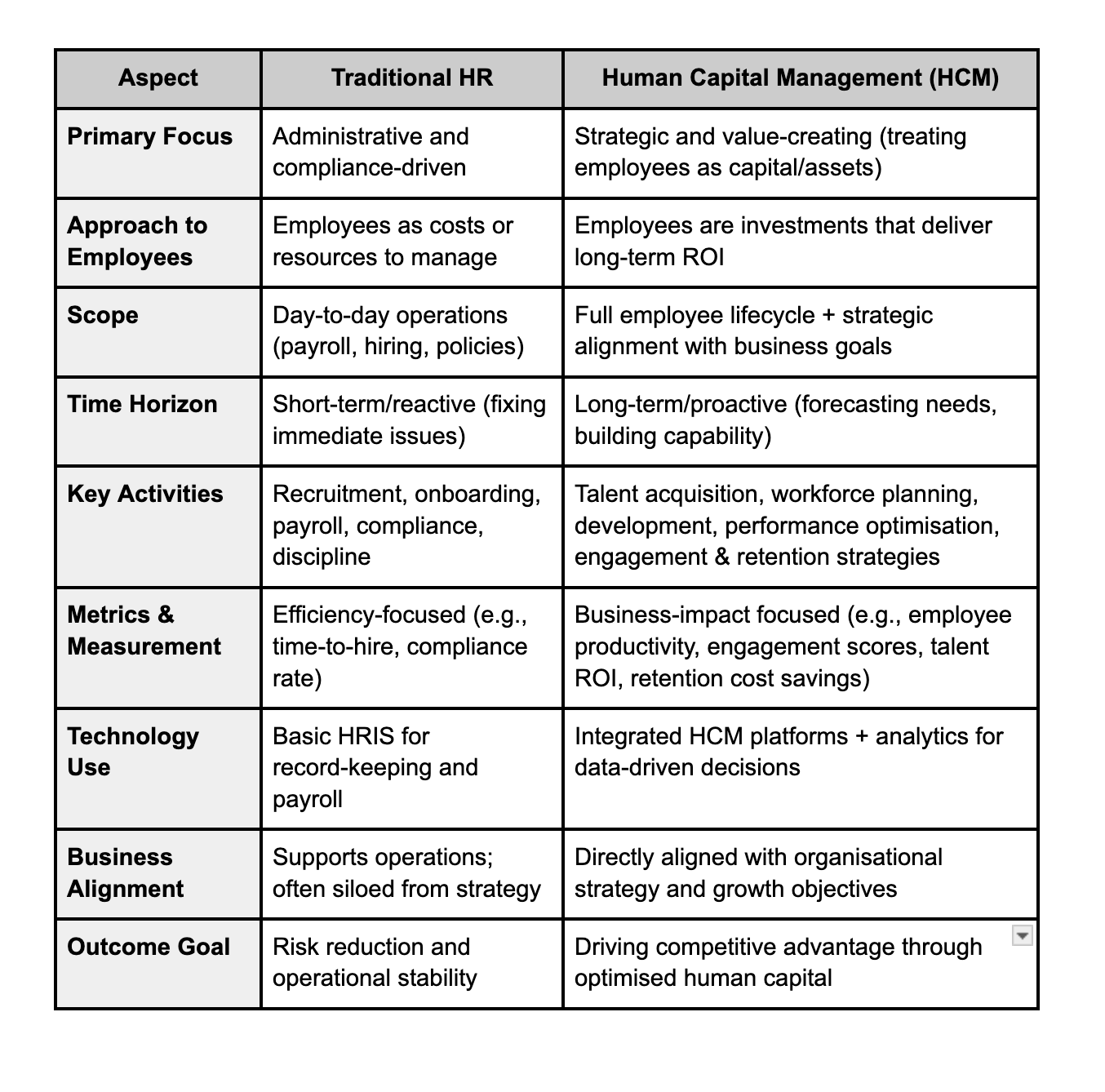
Traditional HR focuses on administrative tasks, often reacting to issues as they arise. HCM, on the other hand, takes a strategic, integrated approach, treating employees as key assets.
It emphasises talent acquisition, development, performance management, and employee retention, using technology and relevant metrics to align workforce decisions with broader business goals.
In a nutshell, traditional HR is operational and compliance-focused, whereas HCM is proactive, performance-driven, and centred on long-term growth.
Key Components of Human Capital Management
HCM is made up of several components, all interconnected to create a seamless employee experience:
Talent Acquisition and Recruitment
One of the most critical elements of HCM is attracting and hiring people who are aligned with the company’s long-term goals and possess the skills required to perform their role effectively.
This includes not only sourcing the talent, but also positioning the organisation as an employer of choice for prospective employees.
Why it matters in HCM
- Reduces turnover by guaranteeing a strong cultural and role fit
- Increases quality of hire and productivity by bringing in the right capabilities
- Creates a strong employer brand by attracting top-tier talent
- Automates and streamlines recruitment workflows, reducing administrative burden
Pain points it addresses
- Skills shortages or over-reliance on contractors
- Long time-to-hire and high recruitment costs
- Poor quality of hire and consequent underperformance or early attrition
Employee Development and Training
After hiring, the role of HCM shifts to training and development, which starts with onboarding and continues through to an employee’s last day with the organisation.
Investing in these areas ensures an employee’s skillset moves alongside the demands and complexity of their role. It turns a company’s workforce into an appreciating asset that drives productivity and innovation, while helping employees progress toward their career goals through initiatives like team coaching programs.
Why it matters in HCM
- Increases job satisfaction and helps retain skilled staff
- Equips employees with knowledge to excel in their roles
- Fosters a growth-oriented culture and improves morale
- Supports internal mobility by preparing employees for role progression
Pain points it addresses
- Skill gaps as roles evolve and technology advances
- High employee turnover driven by limited career progression
- Inconsistent performance driven by uneven access to training
- Over-reliance on external hiring
Strategic Workforce Planning
Knowing who to bring into a company starts with assessing current workforce capabilities, forecasting future talent needs, and addressing gaps – and that’s what strategic workforce planning is all about.
Behind this approach are detailed analytics, which inform decisions around hiring, reskilling, and resource allocation. This allows companies to be one step ahead and plan proactively, rather than react to challenges as they come up.
Why it matters in HCM
- Futureproofs businesses for market shifts, tech advancements, and workforce changes like retirements
- Prioritises critical roles that directly impact business growth
- Maps out clear career pathways, increasing employee motivation
Pain points it addresses
- Lack of accurate workforce data
- Misalignment between hiring and broader business goals
- High recruitment and onboarding costs due to reactive hiring
- Unclear career paths leading to low employee retention
Performance Management and Engagement
As a business evolves, it’s important to regularly check in with employees and ensure their performance continues to support the broader strategy.
This is an ongoing process of monitoring an employee’s contribution against clearly defined goals, and it goes well beyond the annual performance reviews many organisations still rely on.
At the same time, adopting performance management best practices creates opportunities to reward high performers and address issues early by redirecting employees toward priority goals, making it a key component of human capital management.
Why it matters in HCM
- Directly drives productivity and organisational growth
- Helps build a culture of regular feedback, accountability, and development
- Uncovers training needs
- Supports data-driven decisions around promotions and compensation
Pain points it addresses
- Time lost in low-impact work
- Infrequent feedback delaying performance improvements
- Lack of clear expectations and career progression opportunities
- Unfair performance assessments based on subjective opinions rather than data
Compensation, Benefits, and Retention Strategies
To keep top-tier talent in-house, businesses need to reward employees fairly with competitive compensation that keeps pace with inflation, benefits that support their lives both inside and outside the workplace, and retention initiatives that sustain motivation.
By using workforce data, businesses can create compensation frameworks that are not only equitable and transparent but also closely linked to performance and market benchmarks.
Why it matters in HCM
- Reinforces behaviours aligned with business goals
- Supports employee well-being, satisfaction, and loyalty
- Positions the organisation as an attractive employer through a transparent compensation philosophy
Pain points it addresses
- High employee turnover due to feeling underpaid or undervalued
- Unfair pay structures and ineffective, one-size-fits-all benefits packages
- Low morale and quiet quitting
- Pay disparities and non-compliance with employment laws
Benefits of Implementing Human Capital Management Solutions
Throughout this article, we’ve touched on many benefits of implementing HCM strategies across organisational processes. But when you look at the bigger picture, there are three key ways HCM positively impacts both workforce performance and wider business outcomes:
Boosting Productivity and Efficiency
When individual skills and goals align with organisational objectives, and everyone is working toward the same purpose, teams are motivated to work smarter and deliver more.
In fact, companies with highly engaged teams see 23% higher profitability and 18% greater productivity.
Improving Employee Engagement and Retention
HCM is a two-way street: while the focus is often on what the company can gain, it is just as much about the employees’ experience. Staff who feel valued and supported through employee engagement initiatives are more willing to stay loyal to their employer.
Statistics support this: 71% of employees would be less likely to quit if they were recognised more often and businesses that invest in career progression are 67% more confident in their ability to retain qualified talent.
Reducing Costs and Enhancing ROI
By adopting HCM strategies, companies can improve their hiring, onboarding, and retention processes.
They can find and attract the right people for the right roles, and keep them in-house through compensation and development programs that align reward and growth with performance.
The result? Lower turnover, less money spent on recruitment, and less valuable time spent training new employees. Moreover, according to Deloitte, highly effective HCM drives 3.5x revenue growth and 2.1x higher profit margins compared to less effective practices.
Human Capital Management Services: Why HR Outsourcing Wins Over Software Alone
HCM software plays a critical role in modern workforce management, but on its own, it rarely delivers the full strategic value organisations expect, and there are a few reasons why:
- Without expert HR guidance, it can be difficult for employers to interpret all the valuable data the software can surface.
- The software lacks the judgment and context required to manage nuanced situations, such as personal relationships, conflict resolution, or misconduct investigations.
- These tools are built around standardised frameworks, so they don’t always reflect a company’s culture, growth stage, or industry requirements, which could lead to low adoption.
The solution? Pairing the software with HR outsourcing services and getting the best of both worlds: powerful technology supported by human expertise.
The benefits of outsourcing HR
There are countless reasons why companies outsource HR, but the core drivers are efficiency, expertise, and compliance.
- Save on HR-related overhead costs
- Reduce the risk of legal issues and disputes
- Focus on strategic initiatives rather than admin
- Access more and better talent
- Increase employee satisfaction and retention
- Leverage the latest HR tech without the need for direct investment
- Better handle sensitive employee issues
How to Get Started with Human Capital Management
Getting started with HCM doesn’t have to be overwhelming, especially when you have the right partner to guide you.
Assessing Your Workforce Needs
The first step is understanding where your organisation currently stands and where the gaps lie. At HumanX HR, this starts with a comprehensive HR audit that covers all the core elements of HCM, from workforce planning to onboarding, performance management, and more.
This diagnostic approach provides a clear picture of what’s working, what isn’t, and where to focus next.
Building a Custom HCM Strategy
With insights in hand, the focus shifts to crafting an HCM strategy tailored to your organisation’s unique needs. We work closely with businesses to build scalable systems that align with their culture and long-term plans.
This way, HCM initiatives aren’t just implemented, but embedded and driving tangible results across the organisation.
Conclusion
From attracting the right talent and fostering employee development to aligning performance with business goals and rewarding high-performers, HCM touches every aspect of workforce management.
Pair it with experienced HR support, and the outcomes become tenfold, thanks to the context, judgment, and strategic guidance that turn raw data into actionable decisions.
Key takeaways
- HCM transforms employees from operational resources into strategic assets.
- Effective workforce management requires both technology and human expertise.
- Outsourced HR ensures compliance, provides guidance for complex issues, and helps implement best practices.
- A tailored HCM strategy drives retention, engagement, productivity, and measurable business outcomes.
- Continuous alignment of people, processes, and performance is critical to long-term growth.
Sources
- https://www.gallup.com/workplace/236927/employee-engagement-drives-growth.aspx
- https://nectarhr.com/blog/employee-recognition-statistics
- https://www.paycor.com/resource-center/articles/employee-retention-statistics/
- https://www.woodsco.global/news/the-roi-of-human-capital-management-quantifying-the-value-of-people-investments/