

Blog

Table of contents
Workforce optimisation is the process of combining data-driven insights, process automation and targeted training to make teams as productive as possible, keep employees engaged, and ensure operations run smoothly. The primary goal? To supercharge business performance.
Implementing workforce optimisation strategies allows companies to align headcount with demand, streamline workflows, and cut back spending without compromising the quality of the services provided.
In this article, we’re taking a closer look at workforce optimisation: the core components that make it work, the benefits it delivers both in the short and long term, and how it supports broader organisational strategy.
We’ll also explore the challenges that accompany this approach, particularly for teams without the HR knowledge to turn data into action and action into measurable results – and how partnering with external HR specialists can help close that gap.
What is Workforce Optimisation?
Workforce optimisation (WFO) is a strategic approach to improving organisational performance by boosting employee productivity and engagement.
It focuses on everyday operational efficiency and uses data to optimise workflows, manage resources more effectively, and keep running costs under control.
Rather than a ‘set-and-forget’ initiative, workforce optimisation is an ongoing cycle of assessing performance metrics, collating customer feedback, and scanning industry trends to spot areas for enhancement, then taking action to address them.
In practice, workforce optimisation is supported by a few core components:
- Workforce management: Forecasting staffing needs, assigning shifts accordingly, and monitoring in real time to adapt to changing demand.
- Quality assurance (QA): Setting clear goals, reviewing interactions, tracking metrics, and providing feedback to employees.
- Learning and development: Hiring and onboarding the right talent efficiently, while upskilling or reskilling existing employees.
- Tech and analytics: Enabling data-driven decision-making, automating processes, and supporting compliance.
Workforce optimisation can be particularly valuable for medium to large businesses with complex workflows and higher employee counts, where small inefficiencies can quickly become costly.
It provides a structured way to plan, monitor, and adjust workforce activity, bringing consistency and visibility across teams while helping leaders manage performance, costs, and operational risk.
What are the Benefits of Workforce Optimisation?
Workforce optimisation delivers measurable benefits across four key areas:
Improved Efficiency and Productivity
Workforce optimisation allows companies to align staffing levels with demand, so the right number of employees are in place at the right time. It prevents over- or understaffing, reduces both idle time and workload backlogs, and allows employees to focus on high-impact work.
Automation and tech also play a key role. Both help eliminate repetitive manual tasks and free employees to spend more time on meaningful work that drives outcomes, which can increase productivity by up to 40%.
Plus, the focus on targeted training means skills gaps are addressed promptly, with programs that make employees more capable and confident, improving both individual and team performance.
Cost Savings and Resource Allocation
Workforce optimisation reduces labour costs by accurately forecasting demand and lining it up with staff numbers. This reduces money wasted on idle employees, as well as errors or missed deadlines that may occur when teams are spread too thin.
Workforce optimisation also pinpoints and streamlines inefficiencies in workflows, which translates directly into savings, and the targeted upskilling allows employees to handle higher-value tasks, slashing costs for external hires or temporary staff.
Maximising ROI with Strategic Workforce Insights
Though the focus is on day-to-day operations, workforce optimisation also supports smarter strategic decisions that drive long-term value.
It gives businesses a clear picture of what’s working and what isn’t through performance and employee engagement metrics and uncovers skills and resource gaps.
With this information in hand, leaders can make evidence-based decisions that ensure investments in people and processes translate into tangible business results.
Enhanced Employee Satisfaction and Retention
Workforce optimisation directly impacts the employee experience, which in turn drives retention. It ensures all staff have manageable workloads and more flexibility to balance work and life demands.
It also promotes a culture of constructive feedback and recognition, so employees feel valued and engaged, which research suggests can lower turnover by up to 43%.
Plus, it creates more opportunities for career progression, thanks to training programs that align with each employee’s role and professional goals.
How Does Workforce Optimisation Align with Business Strategy?
People are the backbone of any business, and placing them where they can deliver the most value is key to achieving strategic goals. That alone highlights the impact workforce optimisation can have on long-term performance.
Through data-driven insights, automation, and strategic planning, it helps companies become more agile, keep employees engaged, and improve profitability over time.
But for workforce optimisation to deliver its full strategic potential, it needs to be guided by the right people who can look ahead and connect workforce decisions to business priorities.
With expert HR guidance, WFO can go way beyond day-to-day execution and ensure the business has the resources to meet future goals, adapt to change, and scale at the same pace the organisation grows.
Workforce Optimisation Strategies
Common WFO strategies include:
Data-Driven Workforce Planning
Data-driven workforce planning ensures the right people with the right skills are in the right place at the right time, reducing labour costs without jeopardising service quality.
Key elements
- Demand forecasting: Use historical data and business projections to predict staff requirements.
- Capacity planning: Map employee skills and availability to forecasted demand.
- Real-time monitoring: Track productivity to spot resource gaps or surpluses, and pivot as needed.
Performance Management Techniques
Performance management ensures employee output aligns with broader organisational goals and continues to do so over time, as priorities shift.
Key elements
- Goal setting: Establish clear, measurable KPIs for each team member.
- Performance analytics: Continuously track productivity, quality, and engagement metrics.
- Regular feedback: Provide timely feedback to keep employees on the right track, and support them with relevant coaching.
- Recognition: Reinforce desired behaviours and reward high performers.
Learning and Development Initiatives
Learning and development focus on enhancing employee skills and aligning them with organisational needs and strategic goals.
Key elements
- Skills gap analysis: Use workforce analytics to spot skills that need strengthening.
- Targeted training: Deliver upskilling or reskilling programs to bridge identified gaps.
- Career development planning: Mentor employees towards career goals, in line with organisational growth and succession plans.
- Measurement: Track training impact on performance and broader business outcomes.
Leveraging Technology and Outsourcing
Combining the right technology with strategic HR planning allows businesses to optimise operations and focus internal resources on high-value initiatives.
Key elements
- Workforce management software: Track employee performance and resource usage in real time.
- Process automation: Reduce manual tasks and allow more time for high-impact work.
- Integrated analytics: Combine data from multiple tools for an even broader view of your workforce.
- Outsource non-core tasks: Hand off specialised or time-consuming tasks to external partners, for lower costs and greater flexibility.
Challenges in Achieving Workforce Optimisation
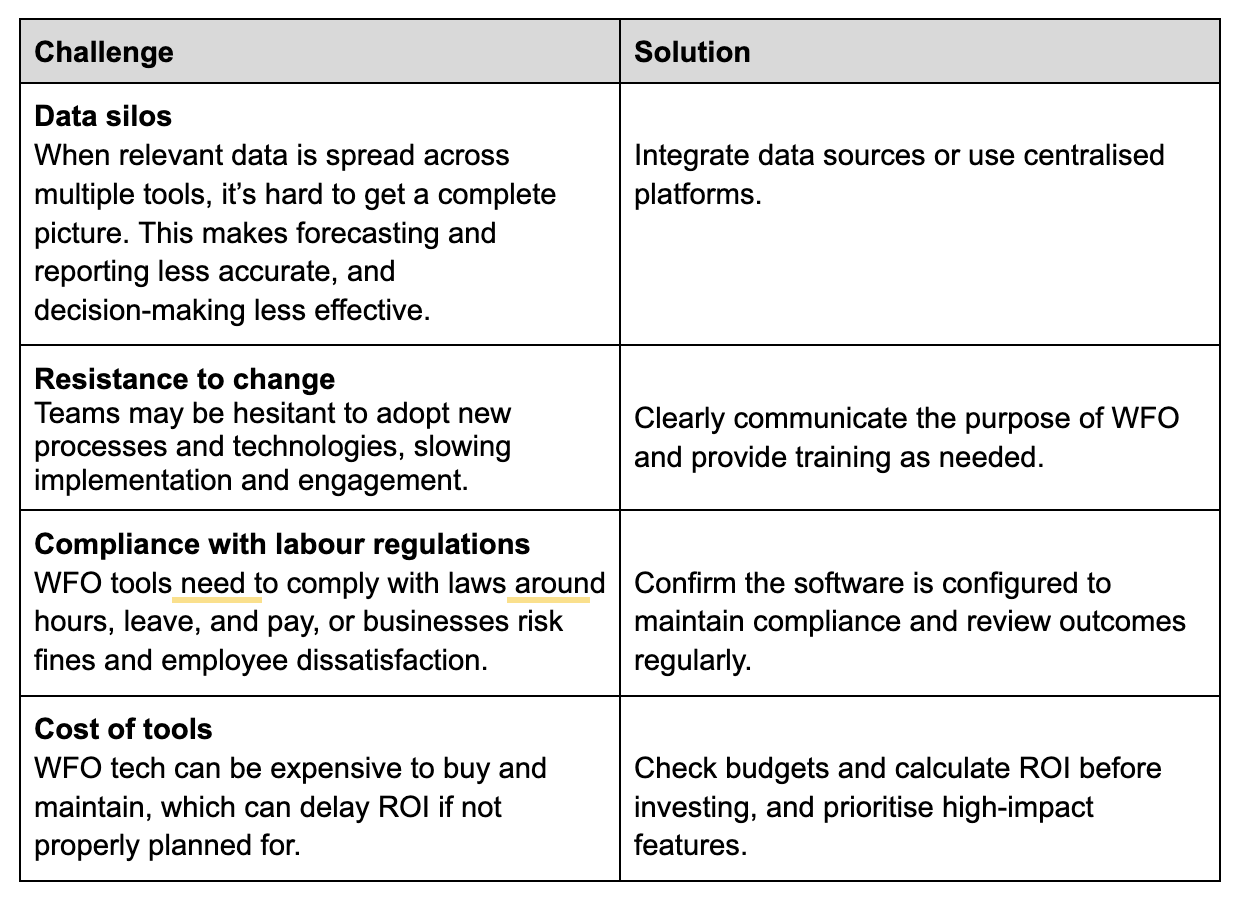
While the benefits of workforce optimisation are evident, this approach isn’t without its hurdles. During implementation, organisations may face:
Combining Workforce Optimisation Software and HR Strategy to Maximise Success
Here’s the thing about the challenges listed above: they often occur when the WFO software is used in isolation, without the expert guidance we touched on earlier. The smartest course of action – the one that delivers the best outcomes – is to combine the tech with human know-how.
In fact, leveraging external HR expertise can make WFO faster and more effective by:
- Guiding the integration of systems and breaking down data silos
- Designing targeted training programs to upskill efficiently
- Aligning processes with labour laws like the Fair Work Act
- Providing best-practice advice and accelerating adoption
Implementing Workforce Optimisation in Your Business
Successfully implementing workforce optimisation requires a structured approach. Put very simply into 5 key steps, it involves:
- Clearly define needs and goals: What is your business wanting to achieve in the next 3-5 years? What roles and capabilities will drive the most success towards those goals?
- Analyse your current workforce: What skills and qualifications does your team have? Is there potential for internal mobility? What’s the turnover and retention rate?
- Project future needs: Are there headcount or skills shortages or surpluses? What will your staffing needs be for the best- and worst-case scenarios?
- Develop and implement a plan of action: Use the insights above to prioritise recruiting, restructure teams (if needed), schedule training sessions, and map succession plans. This is where the WFO software comes in to automate rostering, resource allocation, and track progress.
- Monitor and refine: Establish KPIs for WFO, review the outcomes at least once a year, taking into account input from staff and managers, and improve as needed.
HumanX HR can help you navigate this process and implement WFO in the most seamless way possible, so it doesn’t disrupt day-to-day operations or your employees’ experience. Get in touch and learn how we can make the transition smooth and effective.
Example of Workforce Optimisation
You know the theory, but what does workforce optimisation look like in practice? One great example is Univeler’s U-Work program:
The initiative: The program allowed employees to choose which projects they wanted to work on, combining the stability of a permanent position with the flexibility of freelance-style work.
The benefits: With access to a pre-existing pool of skilled employees, managers spent less time and money on onboarding. Plus, the flexibility of this approach helped retain top talent and attract new team members seeking an adaptable work experience.
The WFO effect: By leveraging strategic workforce planning and advanced WFO technology, Unilever was able to match employees to the projects where they add more value, exactly when and where they were needed – all without extra admin or manual scheduling.
Workforce Optimisation with HumanX HR
WFO is more than a set of tools. It’s a holistic framework that helps businesses get the most out of their teams while reducing costs and driving measurable ROI. Implementing it effectively, though, requires experience and strategic insight. And that’s where HumanX’s HR outsourcing and consulting can make a real difference.
Our team of HR specialists works right by your side to help guide your strategy, streamline implementation, and turn workforce optimisation into a true competitive advantage.